Docker Announces First-Party VMM Public Beta for Mac and Windows
Docker has released its first-party Virtual Machine Monitor in public beta, aiming to improve startup times and memory management for Docker Desktop users.
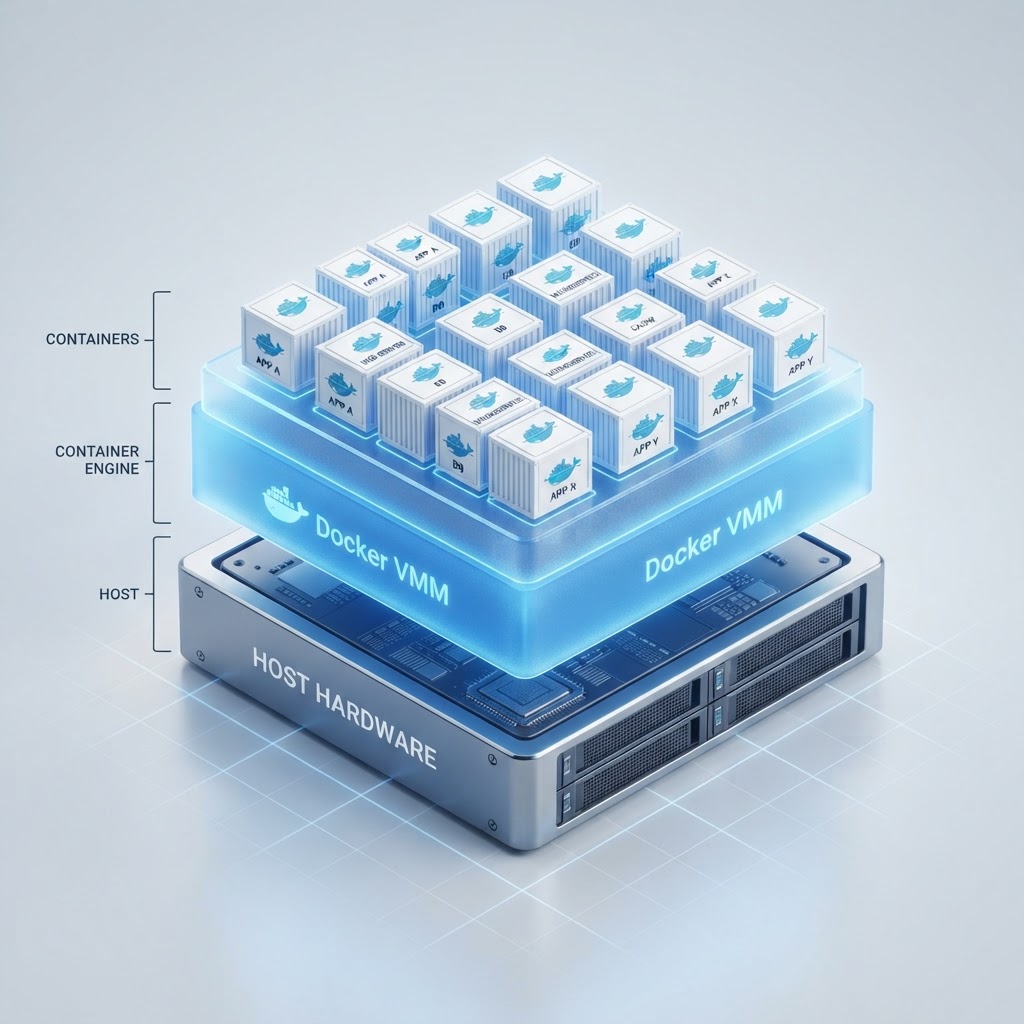
The new Docker VMM provides a first-party virtualization layer directly between host hardware and the Docker Engine.
- Docker VMM is a new first-party virtualization layer available in public beta for Docker Desktop v4.86 on macOS and Windows.
- The update introduces optimized file I/O, faster container startup, and dynamic memory reclamation to the host system.
- General Availability is scheduled for late October 2026, which will include support for Linux environments.
A Shift to First-Party Virtualization
Docker has officially announced the public beta of its new Docker VMM, a rebuilt virtualization monitor designed to serve as the foundational layer for Docker Desktop. Historically, Docker Desktop has utilized third-party virtualization monitors to manage the Linux-native Docker engine on non-Linux operating systems such as macOS and Windows. The transition to a first-party solution represents a move toward full-stack ownership, allowing for optimizations specific to containerized workloads.
A Virtual Machine Monitor (VMM) acts as a critical intermediary between the physical hardware of a host machine and the virtualized environments where containers operate. While this layer is often transparent to developers, it dictates the efficiency of resource allocation, file system synchronization, and system stability. By developing its own VMM, Docker aims to address common pain points related to memory retention and latency in file sharing between host and guest environments.
Key Performance Metrics and Technical Enhancements
The public beta introduces several technical improvements targeted at developer productivity. One of the most significant changes is the implementation of smarter memory management. In previous iterations, Docker Desktop often retained a static amount of RAM even when containers were idle. The new Docker VMM is designed to return unused memory to the host operating system dynamically, reducing the resource footprint of the application during periods of low activity.
File I/O performance has also been prioritized. The communication between the host filesystem and the container is a frequent bottleneck in web development and software builds. According to Docker, the new VMM optimizes file sharing, which reduces the duration of edit-compile-test cycles. Additionally, container startup times have been reduced across various scenarios, including initial launches, project switches, and recovery after a restart.
Platform-Specific Improvements
For Windows users, the introduction of Docker VMM provides a path that balances the characteristics of Hyper-V and WSL2. It offers the isolation expected from a dedicated virtual machine while maintaining the operational speed associated with lighter-weight subsystems. This marks the first time Windows developers will utilize a VMM developed and maintained directly by Docker.
On macOS, the new engine integrates with the existing settings for users already participating in earlier virtualization tests. The update to Docker Desktop v4.86 is the primary requirement for accessing these features. While the initial beta focuses on Mac and Windows, Docker has confirmed that Linux support is currently in development and is slated for the General Availability release.
Integration with Docker Sandboxes
The architecture powering Docker VMM is not limited to Docker Desktop; it also serves as the engine for Docker Sandboxes (SBX). This shared foundation ensures that improvements made to the virtualization layer—such as governance controls and security isolation—are applied consistently across both local and cloud-based environments. The goal of this unified runtime is to provide a consistent experience for containers, Compose applications, and AI agents regardless of whether they are running on a local laptop, on-premise servers, or in the cloud.
This unified approach is also intended to streamline enterprise administration. By owning the virtualization stack, Docker can implement tighter governance controls and administrative features directly into the engine, rather than relying on the capabilities of external third-party virtualization providers.
Release Roadmap and Availability
The public beta phase is expected to continue through the fall of 2026. During this period, Docker will focus on refining the engine based on telemetry and feedback regarding build speeds and file synchronization patterns. The company has set a target for General Availability (GA) at the end of October 2026. At that stage, Docker VMM will become the default virtualization engine for all new installations of Docker Desktop across all supported platforms, including Linux.
Users interested in testing the new virtualization layer can opt in via the Docker Desktop settings. On Windows, this is located under the "General" tab in the Settings menu. On macOS, users already utilizing the experimental virtualization features will be transitioned to the new VMM upon upgrading to version 4.86. Docker is currently gathering feedback through its community Slack channels and in-product surveys to inform final adjustments before the GA release.
Enjoyed this?
Get more posts like this delivered to your inbox.

