Google Colab CLI: Zero-Friction GPU Provisioning for AI Agents
Google's new open-source Colab CLI bridges your local terminal and remote runtimes, bringing instant GPU/TPU provisioning to developers and AI agents.
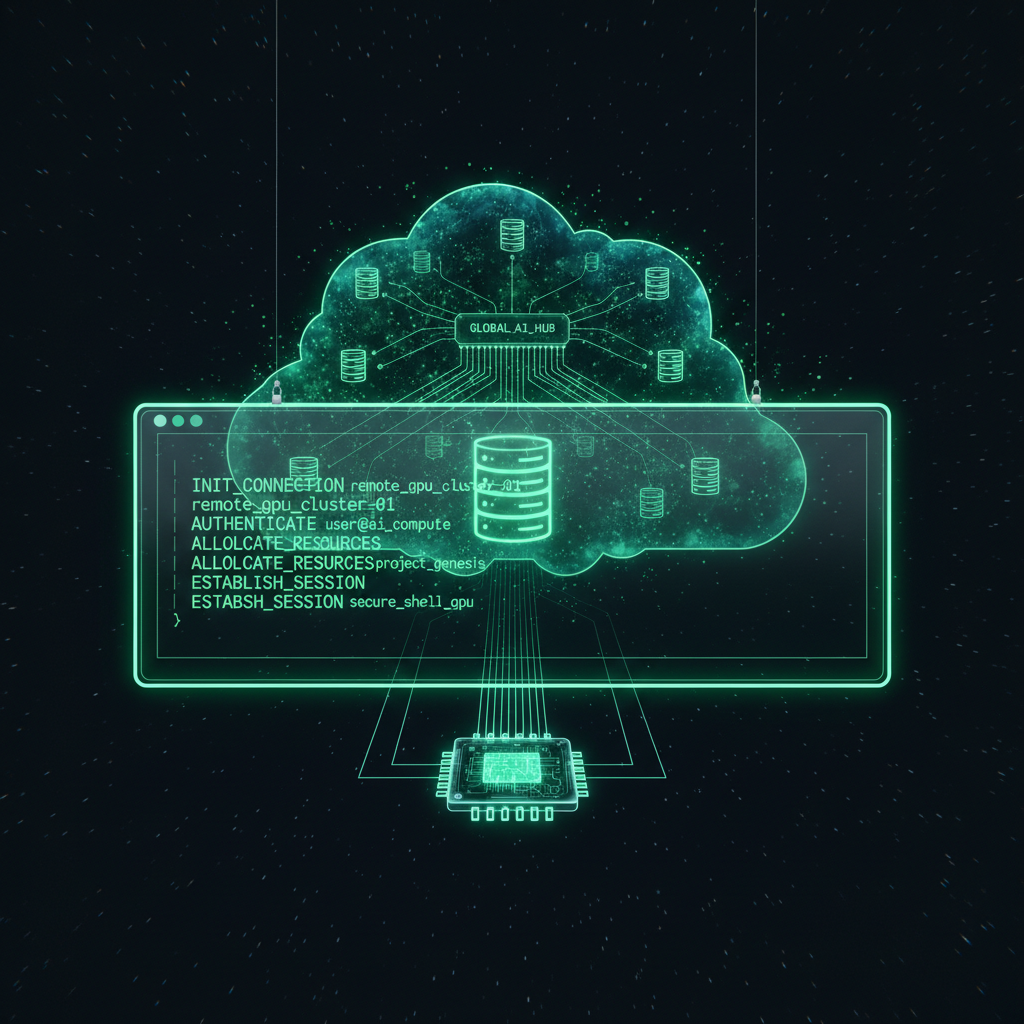
The Colab CLI unlocks seamless terminal-to-GPU workflows for developers and AI agents.
For years, machine learning engineers have loved Google Colab for its accessible, zero-config GPU compute. However, jumping between a local terminal, a code editor, and a browser-based Colab notebook has always introduced a frustrating layer of friction. That all changed on June 5, 2026, when Google officially introduced the Google Colab Command-Line Interface (CLI).
Spearheaded by the Google for Developers team—including Product Manager Spencer Shumway and Software Engineers Tyler Pirtle and Seth Troisi—the Google Colab CLI bridges the gap between your local terminal and remote Colab runtimes. Distributed under the Apache-2.0 license, this lightweight, open-source tool transforms Colab from a web application into an on-demand, headless compute service tailored for both human developers and autonomous AI agents.
Breaking Out of the Browser
Before the Colab CLI, leveraging a high-performance GPU (like an NVIDIA A100) or a Google TPU required opening a notebook in the browser, manually executing cells, and maintaining an active session tab. The new CLI bypasses the graphical interface entirely, bringing powerful hardware directly into your natural shell environment.
With a handful of commands, users can provision instances, manage dependencies, and execute complex machine learning pipelines remotely. Key commands include:
- colab new: Instantly request and provision a high-powered accelerator (e.g.,
colab new --gpu T4or--gpu A100). - colab exec: Run local Python scripts directly on the remote Colab hardware.
- colab download and colab log: Recover training artifacts, safely download updated model weights, and pull replayable
.ipynbnotebook logs directly to your local machine. - colab repl and colab console: Drop into an interactive environment directly on your remote machine for debugging and exploration.
Built for Autonomous AI Agents
While developers who live in Vim or local IDEs will immediately appreciate the workflow upgrade, the true superpower of the Colab CLI is its design for AI agents. Autonomous coding assistants often struggle with navigating graphical user interfaces, but they excel in text-based shell environments.
By exposing Colab's infrastructure via standard terminal commands, agents like Claude Code, Codex, and Google's own ecosystem tools can securely orchestrate cloud compute. To make integration completely frictionless, the Colab CLI GitHub repository includes a prepackaged COLAB_SKILL.md file. This acts as a ready-to-use system prompt, instantly teaching any AI agent how to leverage the CLI commands effectively.
Example: Agentic Fine-Tuning with Gemma 3
The Google developers highlighted a real-world scenario using the Antigravity agent. By issuing a single prompt, a developer can instruct the agent to fine-tune the google/gemma-3-1b-it model on a Text-to-SQL dataset using QLoRA.
Instead of manually configuring a cloud virtual machine, the agent natively executes the following command sequence in the background:
$ colab new --gpu T4
$ colab install transformers datasets peft trl bitsandbytes accelerate
$ colab exec -f finetune_run.py
$ colab log --output gemma_finetune_log.ipynb
$ colab stop
After the remote script finishes execution, the agent uses the download command to retrieve the resulting safetensors adapter, tokenizer config, and logs—leaving the developer with a fully fine-tuned local model, all handled autonomously.
Hardware and Ecosystem Context
Depending on your Google Colab tier (Free, Pro, or Pro+), the CLI provides access to a wide array of accelerators, spanning from entry-level T4s and L4s up to H100 GPUs and TPU v5e/v6e hardware. Because it's a simple Python package, the CLI works cross-platform on Linux, macOS, and Windows.
For teams working on data science pipelines, this means you can iterate locally using small sample data on your laptop's CPU, and then seamlessly offload the full dataset processing and heavy-duty model training to a remote A100 GPU without ever rewriting the execution logic or clicking through web forms to configure virtual private clouds. It significantly cuts down the time from prototype to production deployment. The ability to pull interactive read-eval-print loops (REPLs) means that if an error occurs mid-training, developers can debug the remote memory states in real-time, completely erasing the traditional boundary between local and cloud computing.
Interestingly, this release complements Google's earlier release of the Colab MCP Server in March 2026. While the Model Context Protocol (MCP) server provides a structured API specifically for compatible AI assistants, the Colab CLI acts as a universal bash-level bridge—meaning any script, CI/CD pipeline, or terminal-based agent can harness the power of Colab.
Getting Started
The tech industry is rapidly moving toward localized AI orchestration powered by remote scalable compute. By decoupling its hardware layer from the browser, Google has cemented Colab as a foundational infrastructure tool for the agentic era.
To test it yourself, you can install the CLI directly via Python package managers like pip or uv (e.g., uv tool install google-colab-cli). Head over to the official GitHub repo to review the setup instructions, grab the COLAB_SKILL.md for your favorite agent, and start building with zero-friction cloud compute.
Enjoyed this?
Get more posts like this delivered to your inbox.