Anthropic Unveils Claude Fable 5 and Mythos 5
Anthropic launches Claude Fable 5 for general use alongside the unrestricted Mythos 5, introducing extreme agentic capabilities and dynamic safety routing.
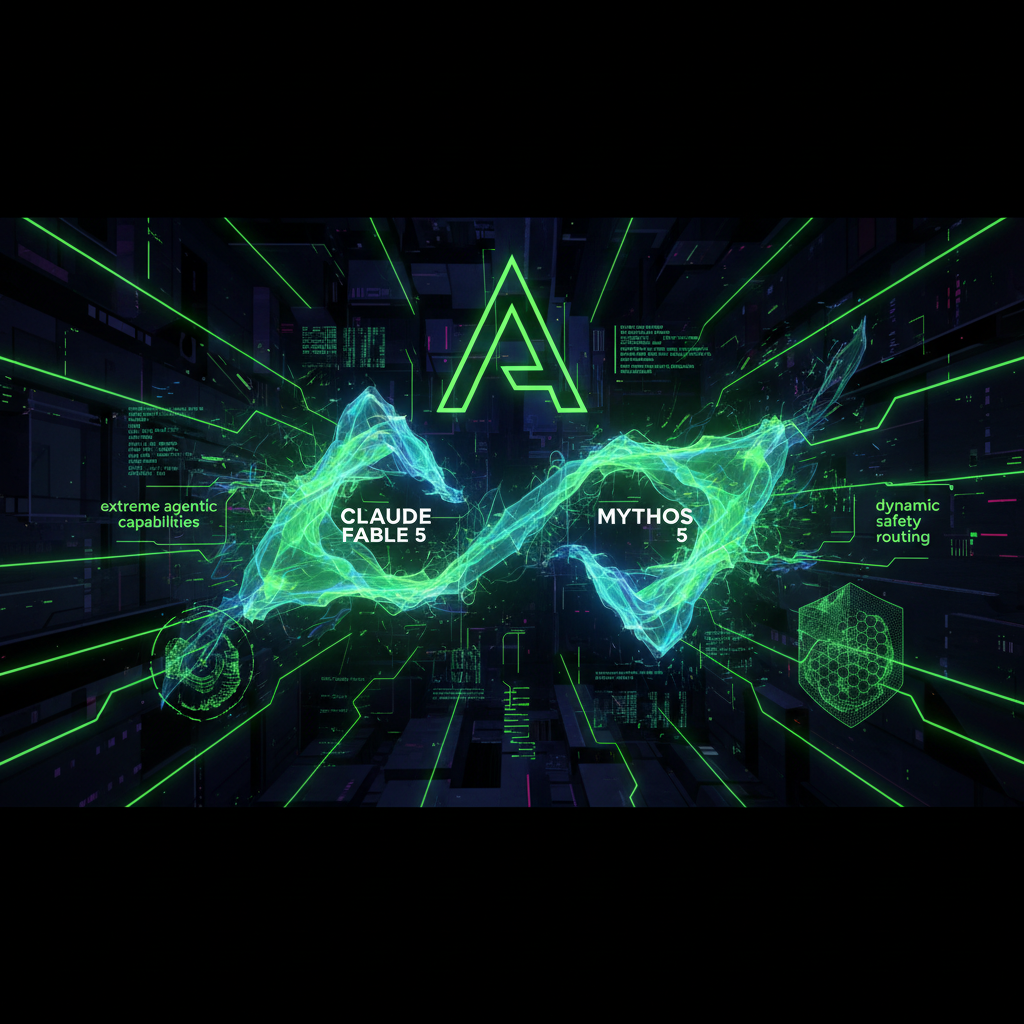
Anthropic's dual-release strategy balances state-of-the-art capabilities with dynamic safety fallback systems.
The Era of Mythos-Class Models Has Arrived
In a major leap for frontier AI capabilities, Anthropic has officially launched its "Mythos-class" architecture, debuting two new models: Claude Fable 5 and Claude Mythos 5. Released today, June 9, 2026, the dual-tier launch represents Anthropic’s most aggressive attempt to date to balance state-of-the-art autonomous capabilities with the escalating risks of dual-use technology.
Fable 5 is now generally available to developers and the public, boasting performance that eclipses any previous model in Anthropic's lineup. Mythos 5, meanwhile, is the unrestricted powerhouse version of the same underlying architecture, deployed strictly to a trusted cohort of cyberdefenders and infrastructure providers via Project Glasswing.
Priced aggressively at $10 per million input tokens and $50 per million output tokens—less than half the cost of the earlier Claude Mythos Preview—Fable 5 is poised to disrupt autonomous coding, scientific research, and long-horizon knowledge work.
Unprecedented Agentic Software Engineering
Fable 5 isn't just an iterative update; it fundamentally changes the horizon for agentic coding. According to early testing, the model possesses a remarkable ability to work autonomously for extended periods.
- Stripe's Massive Migration: In an early pilot, Stripe utilized Fable 5 to execute a codebase-wide migration on a staggering 50-million-line Ruby codebase. What would traditionally take a full engineering team over two months to complete manually was finished by Fable 5 in a single day.
- FrontierCode and CursorBench: Fable 5 currently scores the highest among all frontier models on Cognition's FrontierCode evaluation, which tests adherence to production codebase standards. Michael Truell, CEO of Cursor, noted,
"Claude Fable 5 is the state of the art model on CursorBench. It's opened up a class of long-horizon problems that were out of reach for earlier models."
GitHub's Chief Product Officer, Mario Rodriguez, echoed this sentiment, emphasizing the model's high reliability in long-horizon coding tasks across the software lifecycle.
Vision and Autonomous Gameplay: "Look Ma, No Harness"
Previous generations of LLMs struggled with continuous visual reasoning without heavy scaffolding. Fable 5 breaks this barrier, establishing a new state-of-the-art baseline for vision tasks.
Anthropic demonstrated this by having Fable 5 play the video game Pokémon FireRed from start to finish. Crucially, it did this using only raw game screenshots—no maps, no navigation APIs, and no extra game-state information. It also successfully played the notoriously complex factory-building game Factorio and the deck-builder Slay the Spire, utilizing its own file-based persistent memory to improve its performance dynamically across millions of tokens.
Beyond gaming, this visual autonomy allows developers to seamlessly rebuild web app source codes directly from UI screenshots and extract precise numeric data from dense scientific charts.
Scientific Breakthroughs: From Genomes to Drug Design
While Fable 5 handles general enterprise tasks (acing Hebbia's Finance Benchmark and IMC's trading evaluations), the unrestricted Mythos 5 is achieving milestones in the hard sciences that boundary-pushing researchers have long anticipated.
Anthropic's internal protein design experts report that Mythos 5 accelerated parts of the drug design process by 10x. Operating with standard bioinformatics tools and zero human assistance, the model executed the entire workflow of a scientist—choosing binding sites, running tools, and recovering from software failures. Out of 14 protein targets, Mythos 5 produced strong drug candidates for nine.
In a blinded head-to-head comparison against Opus-class models, researchers preferred Mythos 5’s molecular biology hypotheses roughly 80% of the time. In fact, one of the model’s novel hypotheses regarding an E. coli protein mechanism was subsequently corroborated by an independent lab.
The Safeguard Solution: Dynamic Fallback to Opus 4.8
With great capability comes a massive attack surface. Mythos-class models excel at discovering software vulnerabilities and executing agentic hacking—skills that are invaluable for cyberdefenders but dangerous in the hands of bad actors. Anthropic's solution for the general-release Fable 5 is an innovative "soft-fail" safety classifier system.
Rather than issuing frustrating, canned refusals when it detects a sensitive prompt (like offensive cybersecurity, biology, or chemistry), Fable 5’s external classifiers intercept the request and silently route it to Claude Opus 4.8. This ensures users still get a high-quality, capable response for benign edge cases without exposing the dangerous "uplift" capabilities of the Mythos architecture.
Anthropic notes that this safeguard triggers in less than 5% of average sessions. The lab spent over 1,000 hours in external bug bounties, and while organizations like the UK AISI have probed the model heavily, no universal jailbreaks have been found on long-form agentic tasks to date.
Looking Ahead
The joint launch of Claude Fable 5 and Mythos 5 marks a maturity point in the AI industry. We are moving past the era of raw parameter scaling and into an era of deep, persistent agentic workflows protected by dynamic safety routing. Fable 5 delivers on the promise of an AI coworker that doesn't just autocomplete code, but plans, executes, and course-corrects across millions of tokens.
Enjoyed this?
Get more posts like this delivered to your inbox.