← all releases
MiniMax·Jun 1, 2026·M3·ai_model
MiniMax M3
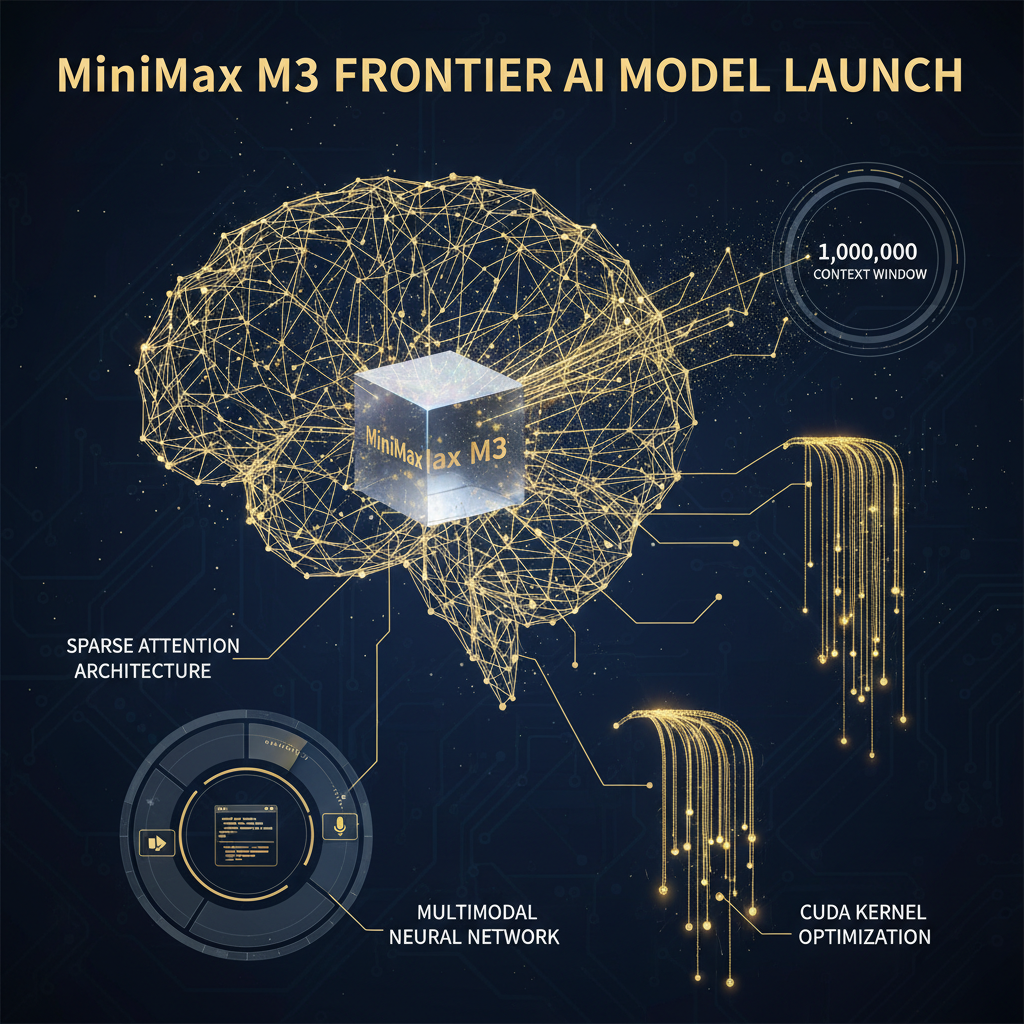
MiniMax M3 is the first open-weight frontier model to combine frontier-level coding, 1M token context via MSA (MiniMax Sparse Attention), and native multimodality (image + video input + desktop control) in a single model. It surpasses GPT-5.5 and Gemini 3.1 Pro on SWE-Bench Pro, beats Opus 4.7 on SVG-Bench, and leads on Claw-Eval for autonomous agents.
featured on blogMiniMaxOpen WeightLLMMultimodalLong ContextCodingAI ModelFrontier Model
 on the blogMiniMax M3: The First Open-Weight Model with Frontier Coding, 1M Context, and Native Multimodality 6 min
overview
MiniMax M3 is the first open-weight frontier model to combine frontier-level coding, 1M token context via MSA (MiniMax Sparse Attention), and native multimodality (image + video input + desktop control) in a single model. It surpasses GPT-5.5 and Gemini 3.1 Pro on SWE-Bench Pro, beats Opus 4.7 on SVG-Bench, and leads on Claw-Eval for autonomous agents.
key features
- 01MSA (MiniMax Sparse Attention) enables true 1M token context — a new sparse attention architecture that partitions KV into blocks more precisely than DSA/MoBA; per-token compute at 1M context is 1/20 of the previous generation, with 9× prefill speedup and 15× decode speedup versus full attention, while matching full attention on nearly all capability benchmarks
- 02Frontier coding and agentic performance — SWE-Bench Pro: 59.0%, Terminal-Bench 2.1: 66.0%, MCP Atlas: 74.2%, KernelBench Hard: 28.8%; demonstrated 24-hour autonomous CUDA kernel optimization improving Hopper FP8 hardware utilization from 7.6% to 71.3% (9.4× speedup) across 147 benchmark submissions with zero human intervention
- 03First open-weight model with all three frontier capabilities — native multimodality (image/video input, desktop computer control) trained from Step 0 with interleaved text+image data scaled to 100T tokens; independently reproduced an ICLR 2025 Outstanding Paper over 12 hours, 18 commits, and 23 experimental figures; available via MiniMax Code, Token Plan, and API
related productsbrowse all →
MiroThinkeropen sourceMiroThinker is an open-source search agent model developed by MiroMindAI, designed for tool-augmented reasoning and real-world information seeking. It aims to match the deep research capabilities of leading AI models like OpenAI's Deep Research and Google's Gemini Deep Research.Letta Code SDKopen sourceThe Letta Code SDK is a software development kit that enables developers to build deeply personalized agents with persistent memory that learn over time. It serves as the interface to Letta Code, facilitating the creation of stateful agents capable of continuous learning and improvement.OB-1open sourceOB-1 is a self-improving coding agent developed by OpenBlock Labs, designed to autonomously handle the full development lifecycle, from project management to pull requests. It integrates seamlessly into existing workflows, enhancing productivity and code quality.