MiniMax M3: The First Open-Weight Model with Frontier Coding, 1M Context, and Native Multimodality
MiniMax has released M3, the first open-weight frontier model to combine top-tier coding performance, a 1 million token context window via the new MSA sparse attention architecture, and native multimodality — all in a single model that can also control a desktop computer.
What Is MiniMax M3?
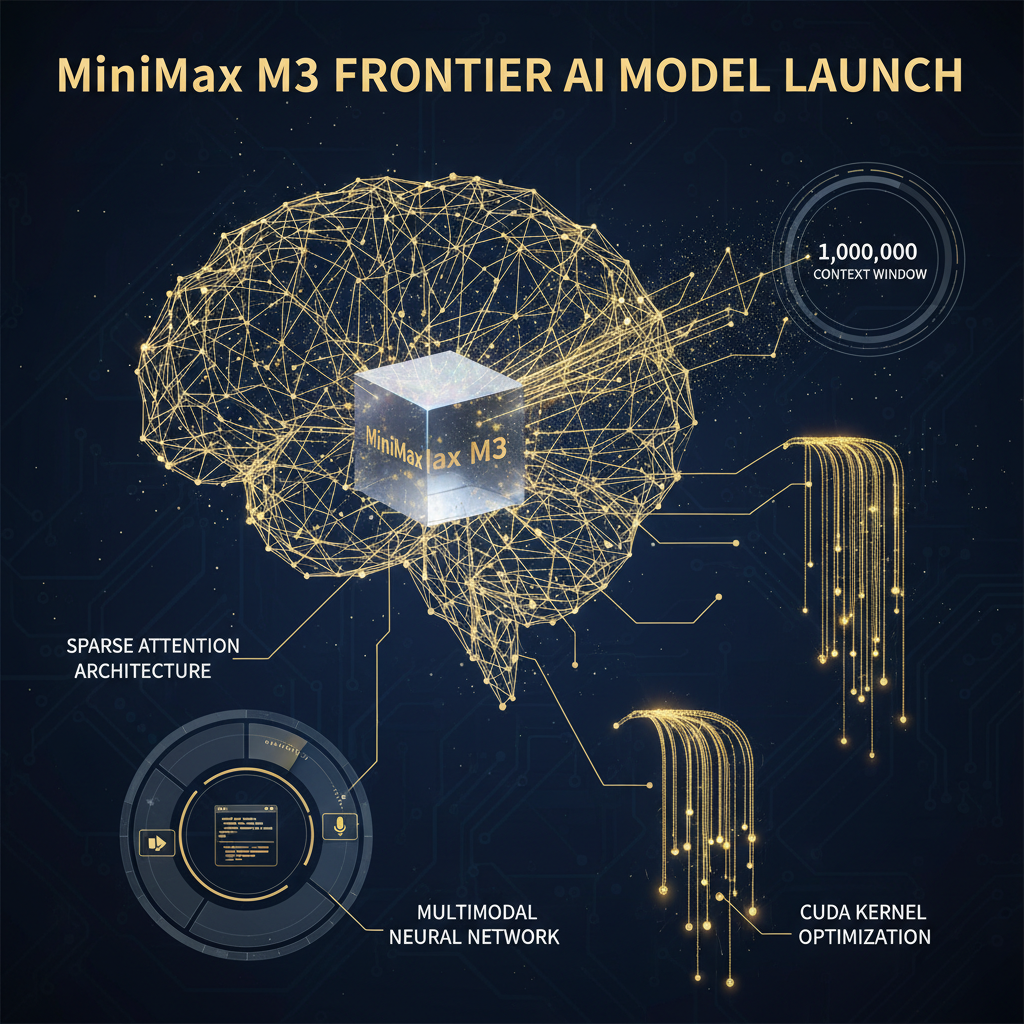
MiniMax M3 launches today as the first open-weight model to bring three capabilities that have previously only existed in closed-source frontier models together in a single package: frontier-level coding and agentic performance, a 1 million token context window, and native multimodality across text, images, video, and desktop computer control.
MSA: A New Sparse Attention Architecture for 1M Context
The 1M context window is powered by MiniMax Sparse Attention (MSA), a new attention architecture developed by the MiniMax team. Standard full attention has quadratic computational complexity — it gets dramatically slower as context grows. MSA solves this by partitioning the KV cache into blocks more precisely than previous approaches like DSA and MoBA.
The practical results are striking:
- At 1 million token context length, per-token compute is just 1/20th of the previous generation model
- More than 9× speedup in the prefilling stage
- More than 15× speedup in the decoding stage
- More than 4× faster than open-source Flash-Sparse-Attention and flash-moba
Critically, across multiple ablations, MSA matched full attention on the vast majority of capabilities — the speed gains come without quality regression.
Frontier Coding Performance
M3 surpasses GPT-5.5 and Gemini 3.1 Pro on SWE-Bench Pro (59.0%) and approaches Opus 4.7. On SVG-Bench, it surpasses Opus 4.7. The full coding benchmark results:
- SWE-Bench Pro: 59.0%
- Terminal-Bench 2.1: 66.0%
- SWE-fficiency: 34.8%
- KernelBench Hard: 28.8%
- MCP Atlas: 74.2%
To improve real-world coding performance beyond standard benchmarks, MiniMax built an interactive user simulator framework that trains models on multi-turn developer collaboration — requirement clarification, solution iteration, and continuous task switching — rather than single-turn code generation tasks.
CUDA Kernel Optimization in the Wild
One of the most impressive real-world demonstrations: M3 was given an FP8 matrix multiplication (GEMM) kernel task on NVIDIA Hopper architecture GPUs — a task that typically takes an experienced team one to two weeks. Starting with only a task description and a non-runnable Triton skeleton, M3 ran autonomously for approximately 24 hours, made 147 benchmark submissions, and improved Hopper FP8 hardware peak utilization from 7.6% to 71.3% — a 9.4× speedup. Its best solution appeared on its 145th submission, after pushing through multiple performance plateaus where other models had already quit.
Native Multimodality from Step 0
Unlike models that bolt on multimodal capabilities after text pretraining, M3 underwent mixed-modality training from the very first step. This allows the semantic spaces of different modalities to merge more naturally. The training data was rebuilt to prioritize interleaved data — text and images naturally woven within sequences — and scaled to 100 trillion tokens.
On OmniDocBench, M3 scores above Gemini 3.1 Pro. On Claw-Eval (end-to-end autonomous agent evaluation), M3 achieves the highest score among all tested models.
M3 can also operate a desktop computer, giving it capabilities for real-world agentic tasks that require GUI interaction.
Paper Reproduction Showcase
The MiniMax team demonstrated M3's combined capabilities by giving it an ICLR 2025 Outstanding Paper Award winner and asking it to reproduce the paper independently. M3 ran autonomously for nearly 12 hours, produced 18 commits and 23 experimental figures, and successfully verified the core experimental results — including the squeezing effect in DPO experiments and the Extend mitigation method. The task required all three of M3's capabilities simultaneously: multimodality to read figures, 1M context to hold the full paper and code together, and strong agentic coding to execute over a long session.
Access and Availability
MiniMax M3 is available now via MiniMax Code, the Token Plan, and the MiniMax API. As an open-weight model, it represents a significant push toward making frontier-class capabilities available outside closed API walls.
Enjoyed this?
Get more posts like this delivered to your inbox.