OpenWiki 0.2 Integrates OKF Standard for Codebase Documentation
OpenWiki 0.2 adds support for Google Cloud's Open Knowledge Format, improving documentation structure and search efficiency for AI coding agents.
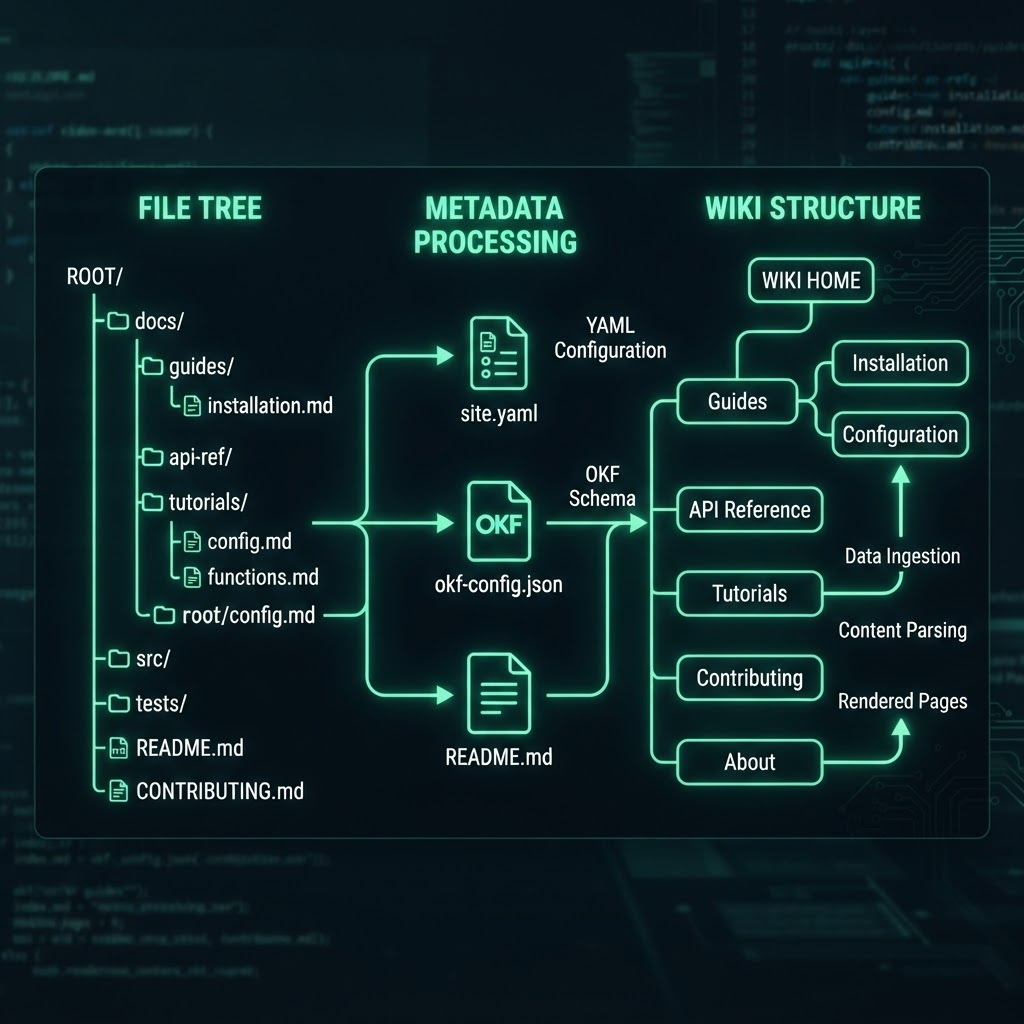
OpenWiki 0.2 implements the Open Knowledge Format (OKF) to structure codebase documentation for better agentic retrieval.
- OpenWiki 0.2 adopts the Open Knowledge Format (OKF), a proposed standard from Google Cloud for structuring knowledge wikis.
- New features include mandatory YAML front matter, standardized directory indexing, and a changelog system to track documentation updates.
- The update aims to reduce token consumption and improve search speed for AI coding agents through deterministic metadata filtering.
Standardizing Codebase Documentation for Agents
OpenWiki has emerged as an open-source command-line interface (CLI) specifically designed to address the challenges of generating and maintaining documentation for complex codebases. The primary function of the tool is to create a wiki for a repository, which then serves as a central knowledge base for AI coding agents. As codebases evolve, maintaining up-to-date documentation becomes a significant hurdle for developers. OpenWiki automates this process, ensuring that the documentation reflects the current state of the code.
With the release of OpenWiki 0.2, the focus has shifted toward improved organization and structure. While the initial release successfully generated Markdown documentation, developers managing large-scale repositories found that disorganized wikis with hundreds of files hindered discovery and searchability. To resolve this, OpenWiki has integrated support for the Open Knowledge Format (OKF), a specification proposed by Google Cloud to standardize how knowledge is stored and navigated within wikis.

The Role of the Open Knowledge Format (OKF)
OKF is designed to provide a predictable structure for technical documentation. By adopting this standard, OpenWiki 0.2 ensures that every generated file contains structured metadata. This metadata is embedded within the YAML front matter of the Markdown files. Key fields included in this front matter are titles, descriptions, tags, categories, and resource URLs. These fields allow for a more granular classification of information than basic file names or directory structures.
The specification introduces two critical file conventions that improve the utility of the wiki: index.md and logs.md. The index.md file acts as a directory-level summary, aggregating information from the files and subdirectories within its path. This provides a high-level overview for both human developers and automated agents. The logs.md file functions as a persistent changelog, tracking every update made to the wiki over time. This allows agents to perform incremental reads, checking the log to identify which files have changed rather than reprocessing the entire knowledge base during every session.
Improving Retrieval Efficiency for AI Agents
One of the primary beneficiaries of the OKF integration is the AI coding agent. Agents typically access these wikis through specialized files such as AGENTS.md or CLAUDE.md. In previous versions, agents often relied on semantic search or open-ended scanning of Markdown files to find relevant context. While effective, these methods can be computationally expensive, often requiring significant token usage and time to navigate large directories.
By implementing OKF, OpenWiki 0.2 enables deterministic search capabilities. Agents can now filter documents based on specific metadata fields, such as tags or categories. For instance, an agent tasked with a billing-related bug can specifically target files tagged with "billing" or categorized under "BigQuery tables," rather than performing a full-text search across the entire repository. This structured approach reduces the time agents spend searching for context and minimizes the tokens consumed during the retrieval process.
Expanding the Ecosystem and Visualizer Support
Because OKF is an open format, OpenWiki users are no longer limited to the tools provided by LangChain. The adoption of a standard format allows these wikis to be compatible with a broader ecosystem of community-built viewers, linters, and renderers. Google has released an open-source OKF wiki visualizer that enables developers to inspect the relationships between documents and verify the integrity of their metadata.
Furthermore, the logs.md feature simplifies the workflow for developers who need to review the changes made by the CLI. Instead of manually comparing file diffs, developers can consult the log to see which tables were created or which playbooks were updated. This transparency is essential for maintaining trust in automated documentation tools.
Getting Started with OpenWiki 0.2
Developers currently using OpenWiki can upgrade to the latest version to begin generating wikis in the OKF format. The tool is distributed via npm and can be initialized in any repository with a few commands. The project is maintained on GitHub, where developers can contribute to the ongoing development of the CLI and its integration with the wider OKF ecosystem. For new users, the initialization process creates the foundational directory structure and begins the process of extracting context from the codebase to populate the initial wiki files.
Enjoyed this?
Get more posts like this delivered to your inbox.
AWS Introduces OAuth Support for Model Context Protocol Server
Next →llms-sdk: A Unified Rust Interface for OpenAI and Anthropic APIs
Related Articles

AWS Introduces OAuth Support for Model Context Protocol Server
5 min read
llms-sdk: A Unified Rust Interface for OpenAI and Anthropic APIs
5 min read