How to Use the OpenRouter Subagent to Cut LLM Costs in Half
OpenRouter's new openrouter:subagent server tool allows frontier models to delegate self-contained tasks to smaller, cheaper worker models mid-generation.
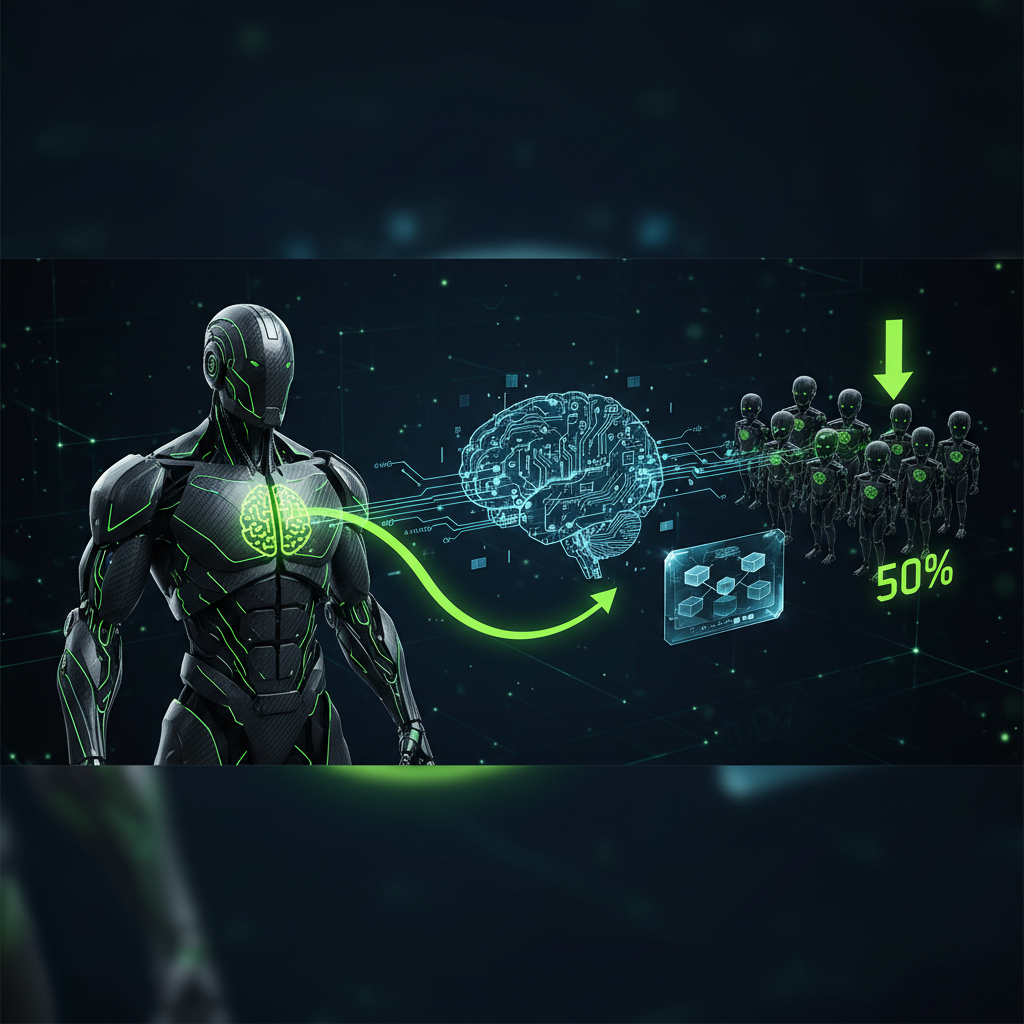
Conceptual diagram of a frontier AI model delegating tasks to efficient worker models.
The High Cost of LLM Orchestration
Building autonomous AI agents usually involves complex multi-step orchestration. When your AI agent parses logs, scrapes messy websites, or audits software changelogs, forcing a frontier model like Anthropic's Claude 3.5 Sonnet or OpenAI's GPT-4o to execute every trivial subtask burns through expensive tokens rapidly. High-intelligence models are essential for planning and final synthesis, but using them for mundane data formatting is an inefficient use of resources.
To solve this, OpenRouter has introduced a powerful architectural fix: the Subagent Server Tool (openrouter:subagent). Currently in beta, this server-side utility allows an orchestrating frontier model to dynamically delegate self-contained tasks to smaller, cheaper, and faster worker models right in the middle of its generation cycle.
How the Subagent Tool Works
While the concept of agentic sub-routines isn't new, OpenRouter's approach natively embeds task delegation directly into the API layer. By offloading mechanical work—such as summarizing a document, extracting structured data, drafting boilerplate, or reformatting text—developers can dramatically reduce costs.
When the main orchestrator model decides a task doesn't require its full reasoning capabilities, it invokes the subagent tool by passing two simple arguments:
task_name: A short, descriptive identifier for the job (e.g.,summarize-changelog).task_description: The complete context, inputs, constraints, and expected output format.
Because the worker model operates in an isolated environment and has no memory of the parent conversation, the orchestrator is instructed to make the task_description exhaustively detailed. The worker executes the instructions and returns its output directly to the frontier model, which then seamlessly integrates the result into its final response.
Choosing and Equipping Worker Models
Developers retain granular control over exactly which model handles the busywork. By configuring the parameters.model field in the tool definition, you can pin a specific, cost-effective model—like ~anthropic/claude-haiku-latest or an open-source model. If left unspecified, the system defaults to using the outer request's model, though the true value of the tool lies in routing down to a cheaper tier.
"The cost split: the orchestrator handles planning and integration via a small token budget, while the worker handles bulk generation, keeping per-token costs incredibly cheap."
Granting Workers Their Own Tools
Delegation with OpenRouter isn't limited to plain text generation. You can arm your worker models with their own OpenRouter Server Tools. By passing a tools array into the subagent parameters (such as openrouter:web_search or openrouter:web_fetch), the subagent can perform multi-step web retrieval and grounding before passing its final synthesized text back to the orchestrator.
Note: Custom function tools ({"type": "function"}) are strictly rejected with an HTTP 400 error if passed to a subagent. Because worker models execute entirely on OpenRouter's servers, they lack the client-side executor needed to fulfill arbitrary function calls.
Parsing the Tool Returns
For developers monitoring system observability, the server tool's return payloads are clean and structured. On a successful execution, the tool result contains the outcome text, the task name, and the exact model that produced it:
{
  "status": "ok",
  "model": "anthropic/claude-haiku-4.5",
  "task_name": "summarize-changelog",
  "outcome": "Release 2.4 highlights: 1) New streaming API..."
}
If a failure occurs, the result returns a "status": "error" along with an error message. Crucially, the calling model receives this error and can smoothly continue its generation process without crashing the entire workflow.
Built-in Guardrails: Recursion and Cost Protection
Giving AI models the ability to autonomously spawn subagents introduces the risk of infinite loops and runaway API costs. OpenRouter has implemented strict technical safeguards to prevent nested model recursion:
- Self-Reference Checks: A subagent cannot invoke itself. The system actively rejects subagent entries inside the subagent's own tools array, and explicitly blocks the subagent tool name from being used as the
workermodel. - Depth Limits: Every inner subagent call carries an
x-openrouter-subagent-depthheader. The subagent tool is automatically stripped from nested sub-calls, ensuring workers cannot re-enter the subagent execution loop. - Execution Caps: Task executions are hard-capped per API request to firmly bound both latency and financial cost.
Additionally, developers can define max_completion_tokens and reasoning effort parameters within the tool definition to tightly restrict the generation ceiling of the worker models.
The Future of Agentic Architecture
The introduction of the openrouter:subagent tool fundamentally upgrades how engineers should architect LLM pipelines. Instead of stringing together multiple separate API calls in custom application logic—or conversely, forcing a single expensive model to do everything—you can now rely on intent-driven delegation executed entirely server-side.
By utilizing the subagent alongside OpenRouter's other sophisticated features (like the deliberative Advisor tool), developers can achieve the holy grail of AI agent design: radically cutting per-request token costs without ever compromising the quality ceiling of the final output.
Enjoyed this?
Get more posts like this delivered to your inbox.