Poolside Releases Laguna XS 2.1 for Local Agentic Coding
Poolside has launched Laguna XS 2.1, a 33B MoE model optimized for local agentic coding under the permissive OpenMDW-1.1 license.
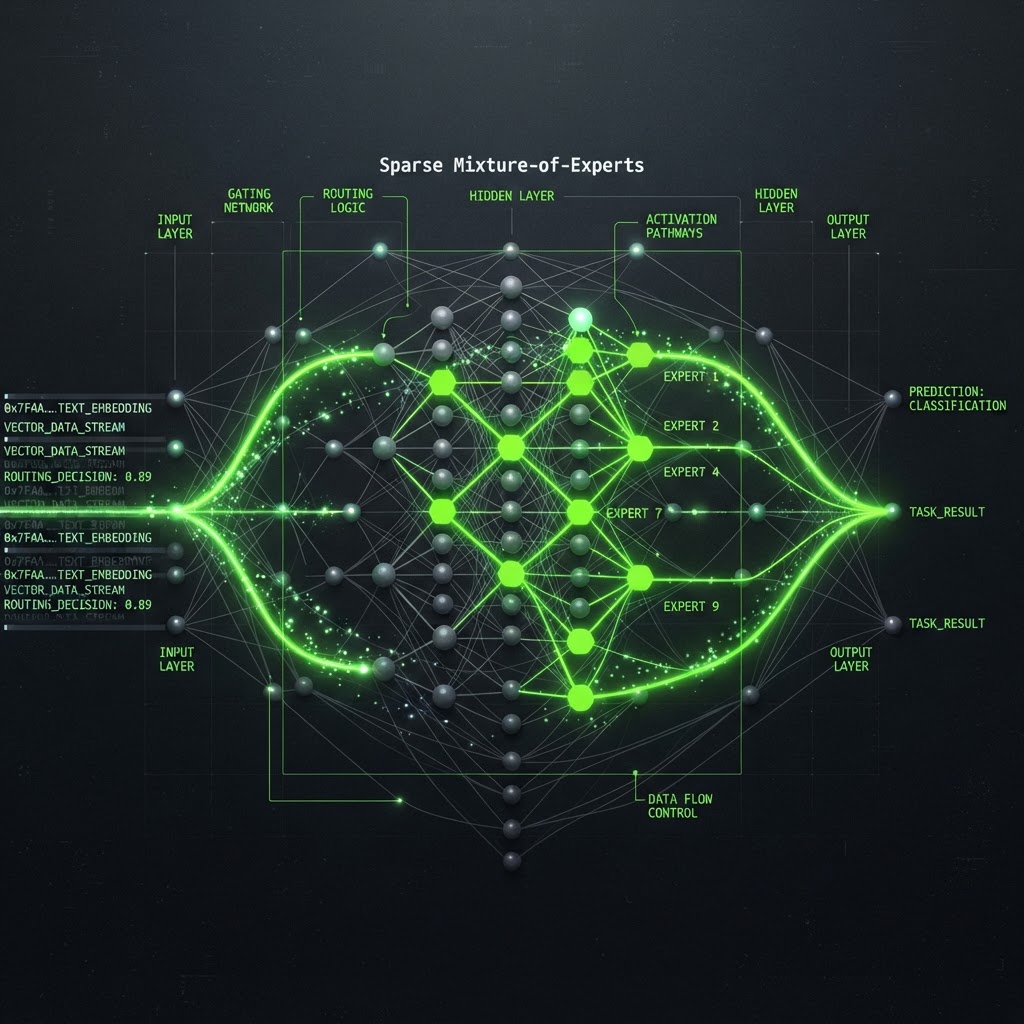
Abstract visualization of a localized Mixture-of-Experts neural network processing structured coding commands.
- Poolside releases Laguna XS 2.1, a 33B total parameter MoE model (3B active) optimized for agentic coding.
- The model features a 256K context window, interleaved reasoning, and mixed sliding-window attention.
- Available on Hugging Face in FP8, INT4, NVFP4, and GGUF for local execution.
- Includes a 0.5B DFlash draft model for speculative decoding, enabling 1.67x to 2.64x speedups.
- Licensed under the Linux Foundation's permissive OpenMDW-1.1 framework.
In July 2026, AI research company Poolside released the Laguna XS 2.1 model family on Hugging Face. Designed specifically for long-horizon software engineering workflows and agentic coding, the release targets developers looking to run capable coding assistants on local hardware. The models are distributed under the permissive OpenMDW-1.1 licensing framework, offering an open-weight alternative to API-only coding agents.
Architecture and Mixture-of-Experts Design
The core model in this release, Laguna XS 2.1, relies on a sparse Mixture-of-Experts (MoE) architecture. While the model contains a total of 33 billion parameters, it activates only 3 billion parameters per token during inference. The MoE routing system utilizes 256 individual experts alongside one shared expert, routing each token through the top eight most relevant paths. This sparsity ensures the model maintains a lower computational overhead, which is necessary for rapid iteration in local terminal environments.
To support long-horizon software development tasks, Laguna XS 2.1 is built with a 256,000-token context window. Managing such a large context efficiently requires specialized attention mechanisms. Poolside implemented a mixed attention approach across the network's 40 layers. Specifically, the model interleaves 30 sliding-window attention layers—configured with a window size of 512 tokens—with 10 global-attention layers. Each layer utilizes rotary scaling. Furthermore, the model is trained to output native thinking blocks. This interleaved reasoning allows the model to internally plan and evaluate steps before emitting formal tool calls via Poolside's custom XML-style protocol.
Accelerating Inference with DFlash Speculative Decoding
To address the latency inherent in local model execution, the Hugging Face collection includes a specialized draft model named Laguna-XS-2.1-DFlash. Speculative decoding operates by using a smaller, faster model to predict upcoming tokens, which the larger main model then verifies in parallel. DFlash is a 0.5-billion parameter, 5-layer Llama-style speculator tailored specifically to the output distribution of the 33B main model.
In practice, DFlash proposes up to 15 candidate tokens per step. When the 33B Laguna model validates these tokens, the system skips multiple standard generation steps. According to deployment documentation, this pipeline yields end-to-end speedups ranging from 1.67x to 2.64x across standard evaluation datasets, with an average acceptance rate of 3.55 to 4.57 tokens per inference step. This significantly reduces time-to-first-token and overall generation time for complex, multi-step coding agent tasks.
Quantization Ecosystem and Local Deployment
Operating a 33B parameter model and a 256K context window requires careful Video RAM (VRAM) management. To accommodate a wide range of local hardware configurations, Poolside published several quantized checkpoints directly to the Hugging Face collection. The provided formats include 8-bit floating point (FP8), 4-bit integer (INT4), NVIDIA's NVFP4 format, and standard GGUF variants for CPU and GPU split execution.
The FP8 version incorporates a native FP8 key-value (KV) cache, reducing the memory footprint required to maintain long context histories during agent sessions. The Laguna XS 2.1 model family is actively supported across multiple inference engines, including vLLM, SGLang, Ollama, and NVIDIA TensorRT-LLM, ensuring compatibility with standard developer tooling and Poolside's own terminal-based coding agent.
Benchmark Performance Context
Laguna XS 2.1 was evaluated against standard industry software engineering benchmarks, functioning as a direct upgrade to its predecessor, Laguna XS.2. In the SWE-bench Multilingual evaluation, the model scored 63.1%, an improvement of 5.4 percentage points over the previous version. On the standard SWE-bench Verified dataset, Laguna XS 2.1 resolved 70.9% of the issues.
The benchmark tests were conducted using specific operational limits to simulate real-world local usage. Tasks were executed within sandboxed environments restricted to 8 gigabytes of RAM and two logical CPUs, operating within a maximum limit of 500 agent steps. The sampling parameters were kept consistent across tests, operating at a high temperature (1.0) with thinking mode explicitly enabled.
The OpenMDW-1.1 License Framework
A notable aspect of the Laguna XS 2.1 release is the adoption of the OpenMDW-1.1 license. Formally released by the Linux Foundation in May 2026, OpenMDW (Open Model, Data and Weights) is a model-first legal framework designed to address the complexities of AI distribution. Traditional open-source software licenses frequently fail to encompass model weights, training data, and documentation adequately.
Under OpenMDW-1.1, the Laguna XS 2.1 weights, software, and associated documentation are released permissively. The license grants users unrestricted rights to modify, fine-tune, and redistribute the materials. Furthermore, the agreement explicitly states that it imposes no restrictions on the outputs generated by the model, clearing a common legal ambiguity for enterprise users deploying the model in commercial software pipelines.
For users who prefer not to run the model locally, Poolside provides managed access via a commercial API, priced at $0.06 per million input tokens and $0.12 per million output tokens.
Enjoyed this?
Get more posts like this delivered to your inbox.
AWS Introduces Amazon S3 Annotations for Scalable, Mutable Object Metadata
Next →OpenWiki: LangChain Releases Open Source Repo Documentation Agent
Related Articles

CopilotKit Releases Open Intelligent UI: An Open-Source Generative UI Framework
4 min read
Qodex AI Launches OpenQodex: An Open-Source AI Code Reviewer for Claude Code and Codex
4 min read