Datalab Launches Marker 2.0: An Open-Source PDF-to-Markdown Tool Built for RAG Pipeline
Datalab has released Marker 2.0, an open-source tool designed to convert PDFs to Markdown for RAG pipelines with increased speed and accuracy.
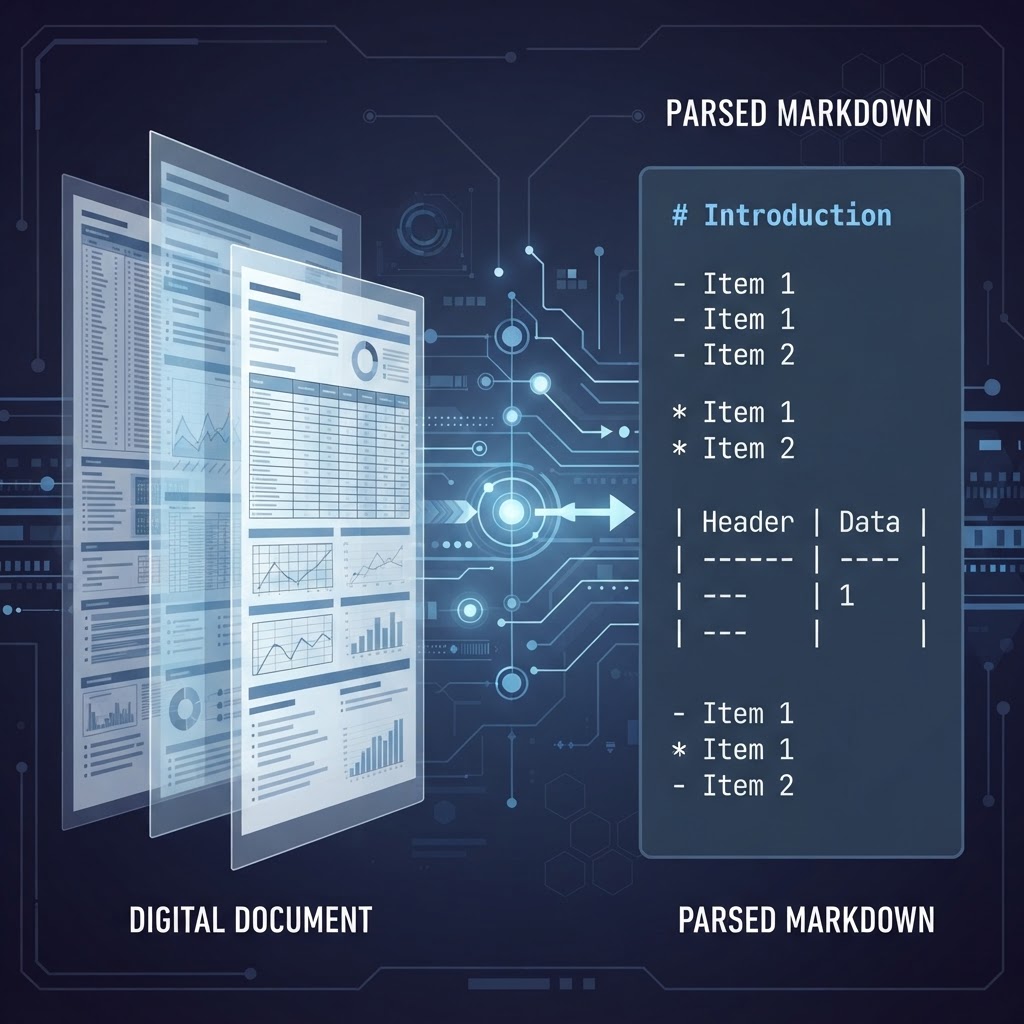
Marker 2.0 utilizes a multi-stage pipeline to convert complex PDF layouts into structured Markdown.
TL;DR
- Marker 2.0 is an open-source tool optimized for converting complex PDFs into clean Markdown for LLM and RAG applications.
- The update features a 2x speed increase over version 1.0 and improved accuracy in handling tables, equations, and multi-column layouts.
- The system utilizes a custom pipeline involving layout detection, OCR, and specialized models for mathematical notation.
Overview of Marker 2.0 Release
Datalab has announced the release of Marker 2.0, a significant update to its open-source PDF-to-Markdown conversion tool. The software is specifically designed to address the challenges of extracting high-quality text and structural data from PDF documents, which remain a primary data source for Retrieval-Augmented Generation (RAG) pipelines and Large Language Model (LLM) fine-tuning. Version 2.0 focuses on performance optimizations, reducing processing time while maintaining high fidelity to the original document structure.
PDFs are notoriously difficult to parse because they are a display format rather than a data format. Traditional extraction methods often struggle with multi-column layouts, embedded tables, and mathematical equations, frequently losing the reading order or misinterpreting text formatting. Marker 2.0 aims to solve these issues by employing a specialized pipeline of deep learning models to reconstruct the document in a format that LLMs can easily ingest.
Technical Improvements and Performance
One of the primary advancements in Marker 2.0 is the increase in processing speed. According to Datalab, the new version is approximately two times faster than its predecessor. This speed gain is achieved through more efficient model architectures and optimized processing loops that allow for higher throughput when handling large batches of documents. In testing environments, the tool has demonstrated a marked reduction in the time required to convert complex academic papers and technical reports.
Beyond speed, Marker 2.0 introduces improvements in memory management. The tool is designed to work within the constraints of consumer-grade GPUs, making it accessible to individual developers and smaller research teams. By optimizing how layout detection and Optical Character Recognition (OCR) models are loaded into VRAM, Marker 2.0 minimizes the hardware overhead previously required for high-accuracy PDF parsing.
The Conversion Pipeline Architecture
The Marker 2.0 architecture relies on a multi-stage pipeline. The process begins with layout detection, using the Surya model to identify structural elements such as headers, footers, sidebars, and images. Identifying these elements is critical for maintaining the correct reading order, as simple text extraction often merges unrelated text blocks from different columns or pages.
Once the layout is mapped, the system applies specialized models for different content types. For instance, mathematical equations are processed using Texify, a model specifically trained to convert visual representations of formulas into LaTeX-compatible Markdown. Similarly, table extraction has been refined in 2.0 to ensure that cell relationships and data structures remain intact during the transition to Markdown tables. This is particularly important for RAG systems, where a misinterpreted table can lead to inaccurate answers from the LLM.
For text extraction, Marker 2.0 supports multiple OCR engines. While it can utilize Tesseract for broader language support, it is optimized for high-fidelity extraction that preserves formatting such as bold and italic text. The final output is a clean Markdown file that includes the extracted text, formatted tables, LaTeX equations, and references to extracted images, providing a comprehensive representation of the original document.
Utility in RAG and LLM Workflows
The transition to Markdown is a strategic choice for AI development. Markdown is significantly more token-efficient than HTML or raw XML and provides enough structural hierarchy (via headers and lists) for LLMs to understand the context of the information. By providing a clean Markdown version of a PDF, Marker 2.0 helps reduce the noise in the input data, which can improve the accuracy of vector database retrievals and the quality of generated responses.
Furthermore, Marker 2.0 includes support for a wide range of languages. The underlying Surya layout model and OCR capabilities allow it to handle documents in various scripts, making it a viable tool for global data processing tasks. The open-source nature of the project allows developers to integrate it directly into their existing data ingestion workflows without the costs or privacy concerns associated with proprietary cloud-based PDF conversion APIs.
Benchmarks and Comparisons
In comparison to other open-source alternatives like Grobid or Nougat, Marker 2.0 positions itself as a versatile middle ground. While Nougat is highly accurate for scientific papers, it can be resource-intensive and slow. Marker 2.0 attempts to bridge the gap by offering similar accuracy for a broader range of document types while maintaining higher throughput. Benchmarks released by Datalab indicate that Marker 2.0 outperforms several common commercial and open-source solutions in terms of preserving document structure and handling non-standard layouts.
The release of version 2.0 also includes updates to the documentation and easier installation procedures, reflecting the project's growth within the AI developer community. As RAG continues to be a dominant architecture for enterprise AI, tools like Marker 2.0 that improve the quality of the
Enjoyed this?
Get more posts like this delivered to your inbox.
Y Combinator Releases QM: An Open-Source Agent Harness With Isolated Sandboxes and Postgres Memory
Next →Microsoft Introduces dynwinrt: A New Way to Bring Native Windows APIs to Node.js (No C++ Required)
Related Articles

Microsoft Open-Sources ThinkingBox to Benchmark AI Agent Side Effects
4 min read
Google Open-Sources ARTEMIS: An AI Android Automation Agent That Automates End-to-End Workflows, Captures Logs, and Connects to AI IDEs via MCP
4 min read